
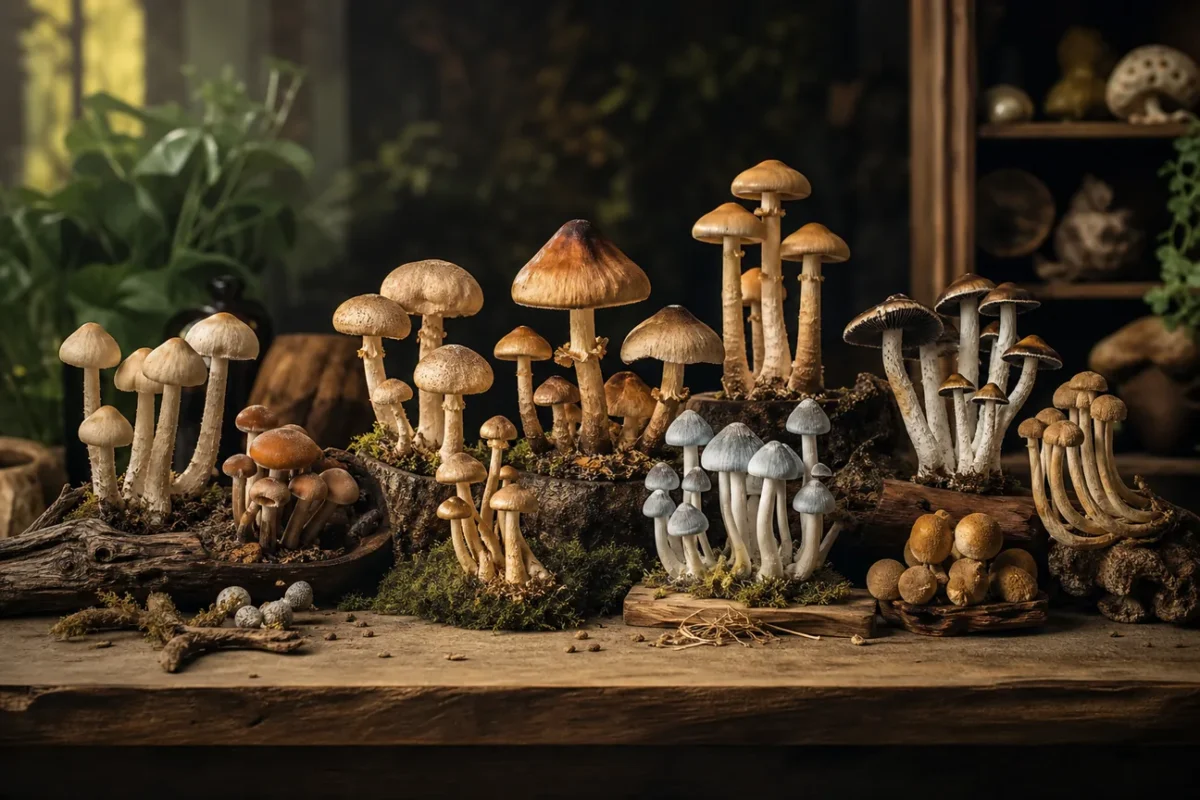
Curious which mushroom names refer to a species and which are cultivar labels? That distinction matters more than a ranked potency list. So, here are 10 names that often appear on lists of the best magic mushroom strains, with a clear look at what the labels can and can’t tell you.
We analyzed 67 comments and questions from Reddit, YouTube and Quora about magic mushroom strains and found that 49% mentioned potency differences between strains.
This is educational information, not a buying or use recommendation. GoldenMystic publishes educational material about psilocybin, but we don’t rank these mushrooms for consumption or provide dosing advice.
1. Psilocybe cubensis, the reference species for most magic mushroom strains
Psilocybe cubensis is a species, not one single strain. Many familiar names, including Golden Teacher and Penis Envy, refer to cultivars associated with this species. That’s why a list of “strains” can mix unlike things: a species name on one line and a cultivar name on another.
In addition, published psilocybin figures for mushrooms vary across sources and specimens. As a result, a species or cultivar label alone can’t tell you the content of a particular mushroom. Growing conditions and individual batches can differ, so you should not treat a name as a test result or a reliable predictor of effects. Our article on magic mushroom potency explains why it varies so much.
Psilocybin can change perception and mood. Moreover, responses can vary from person to person and by circumstances. For example, effects can feel meaningful to some people and frightening to others.
For readers comparing names, treat cubensis as a broad reference point, not a promise of a mild or predictable experience.
2. Penis Envy, one of the cubensis strains often described as potent
Penis Envy is a named cultivar of Psilocybe cubensis. In addition, people widely discuss it for its unusual form and reputation for high potency. However, you should not read that reputation as a measured property of every mushroom sold under the name.
Published figures for this cultivar include a reported average psilocybin content of about 1.0%, with a reported range of 0.9% to 1.1%. However, those figures only summarize reported samples. In other words, they don’t establish the strength of a specific batch, and they aren’t a safe basis for choosing an amount.
Some accounts tell a dramatic origin story involving early collectors and cultivators. Sources disagree on the historical record, so a neat, certain lineage story deserves caution. A more useful distinction is simple: Penis Envy is a cultivar name, while its parent species is P. cubensis.
Because mislabeled or variable products can make a cultivar name unreliable, we don’t treat it as a guarantee. Therefore, if you encounter this label, don’t assume it predicts a particular experience.
3. Golden Teacher, one of the best-known cubensis strains
Likewise, Golden Teacher is another familiar cultivar name within P. cubensis. People often link its name to reports of introspection or insight, but those reports aren’t a dependable forecast for an individual. Psilocybin experiences can differ widely, even when people use the same name for a product.
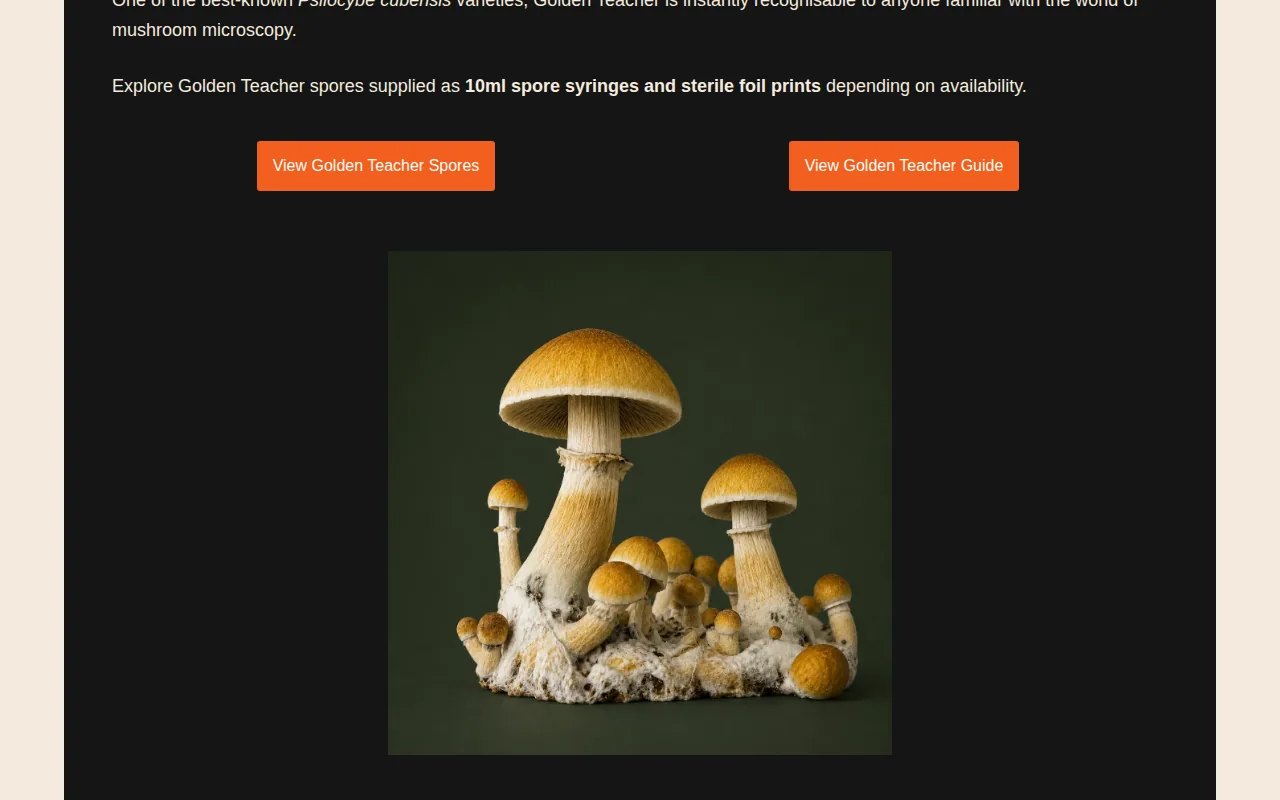
Golden Teacher has a broad estimated content range of 0.5% to 1.5%. In short, that span is not a product specification. Instead, it illustrates why online strain comparisons can sound more exact than the underlying evidence supports.
Golden Teacher is a useful example of how names can blend taxonomy with marketing and user lore. In other words, the name doesn’t establish a standardized genetic line, a fixed chemical profile, or an agreed effect profile. Similarly, even an appearance associated with a cultivar cannot confirm identity or safety.
So when you see Golden Teacher described as “gentle” or ideal for a new user, read that as an assertion, not a reliable safety rule. Above all, the name cannot remove the risks of impaired judgment, distress, or unexpected effects.
4. Psilocybe semilanceata (Liberty Cap), a wild magic mushroom species
Most people know Psilocybe semilanceata as Liberty Cap. In contrast to Golden Teacher or Penis Envy, this is a species name, not a cubensis cultivar. It grows wild in some regions, which can make the name appear in conversations about foraging.
However, that does not make wild collection safe. After all, mushroom misidentification can lead to poisoning, and a photo or a common-name description is not enough to confirm a specimen. In fact, some poisonous fungi can resemble edible or psychoactive species. For this reason, we can’t provide a field identification guide or advise anyone to collect wild mushrooms for consumption.
Reports of its psilocybin content vary, and a species-level figure cannot establish the contents of an individual mushroom. The broad effects of psilocybin may include altered perception, changes in mood, anxiety, or panic. Even so, a particular species label does not guarantee which effects someone will have.
Liberty Cap is best understood here as a botanical name with a known misidentification risk, not as a suggestion to forage. Our liberty cap mushroom guide covers its history, legal status and dangerous lookalikes in more detail.
5. Psilocybe azurescens, a species associated with high reported potency
Psilocybe azurescens is a species that reports describe as comparatively high in psilocybin. It also has a reported average psilocybin content of 1.78%. In other words, that is a reported figure, not a dependable measure for every specimen or batch.
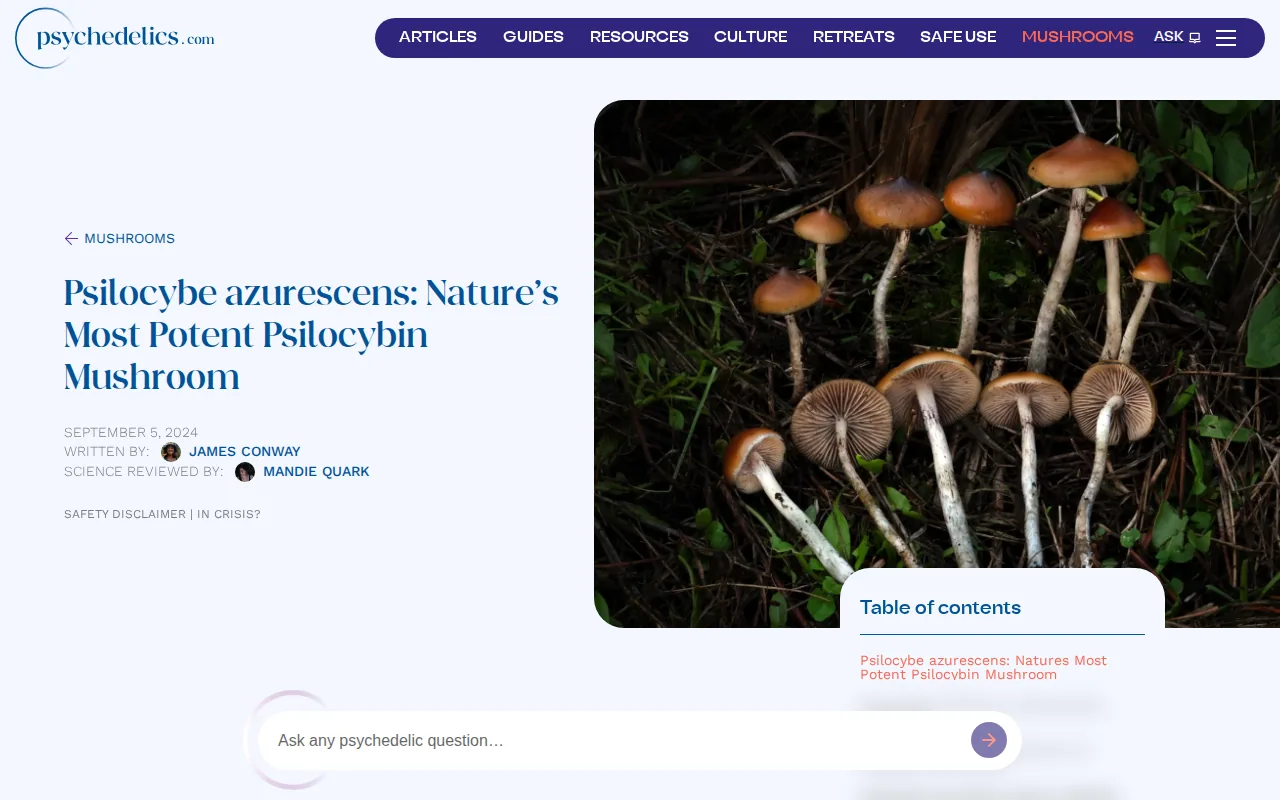
Unfortunately, its reputation can tempt people to use potency rankings as a shortcut. That’s risky. A published average does not tell you how a particular mushroom will affect someone, and you cannot convert it into a safe amount without reliable testing and medical oversight.
You should not treat wild specimens as safe to identify or consume based on this information, and it does not validate a potency claim for a particular sample.
6. Psilocybe cyanescens, a distinct species, not a cubensis cultivar
Psilocybe cyanescens, often called Wavy Cap, is a separate species. It is not a cultivar of P. cubensis. As a result, keeping those categories apart helps readers make sense of strain lists that place cultivar names beside scientific species names.
Psilocybe cyanescens averages 0.85% psilocybin. Like the other figures here, treat it as a broad report, not a batch guarantee. Again, chemical content may vary, and a name alone can’t verify what is present.
Reports also connect this species with wood and mulch habitats. That can lead to amateur identification attempts in parks or garden beds. Therefore, don’t use habitat, color, or a single visual clue to decide that a wild mushroom is safe. After all, toxic look-alikes make that a serious risk.
Psilocybin can affect perception and judgment. As a result, a person may misread their surroundings or feel intense fear. Those risks apply regardless of whether someone describes a mushroom as a cubensis cultivar or a separate species.
7. Panaeolus cyanescens (Pan Cyan), a magic mushroom species outside Psilocybe
Panaeolus cyanescens belongs to a different genus from Psilocybe. Many people simply call it Pan Cyan. In fact, that distinction matters: “magic mushroom” is a broad common label, not a taxonomic group that makes all species interchangeable.
Panaeolus cyanescens has a reported average psilocybin content of 2.5%. Such a number is not an instruction or a safe-use benchmark. It also does not mean every specimen has the same content. Similarly, a high reported percentage cannot predict the intensity or course of an individual experience.
General psilocybin effects can include altered perception and time sense. They can also include nausea, confusion, fear, or panic. In addition, a person’s health, medications, surroundings, and mental state may all affect the risks. Overall, no cultivar or species name can guarantee a positive outcome.
For that reason, we don’t use a “strongest” label as a recommendation. Ranking mushrooms by a single reported number leaves out the uncertainty that matters most to safety.
8. Psilocybe subaeruginosa, a species with high reported content
Psilocybe subaeruginosa is a wood-degrading species reported from Australia. This species has a reported average psilocybin content of 1.93%. That reported average is not a reliable measure of an individual mushroom.
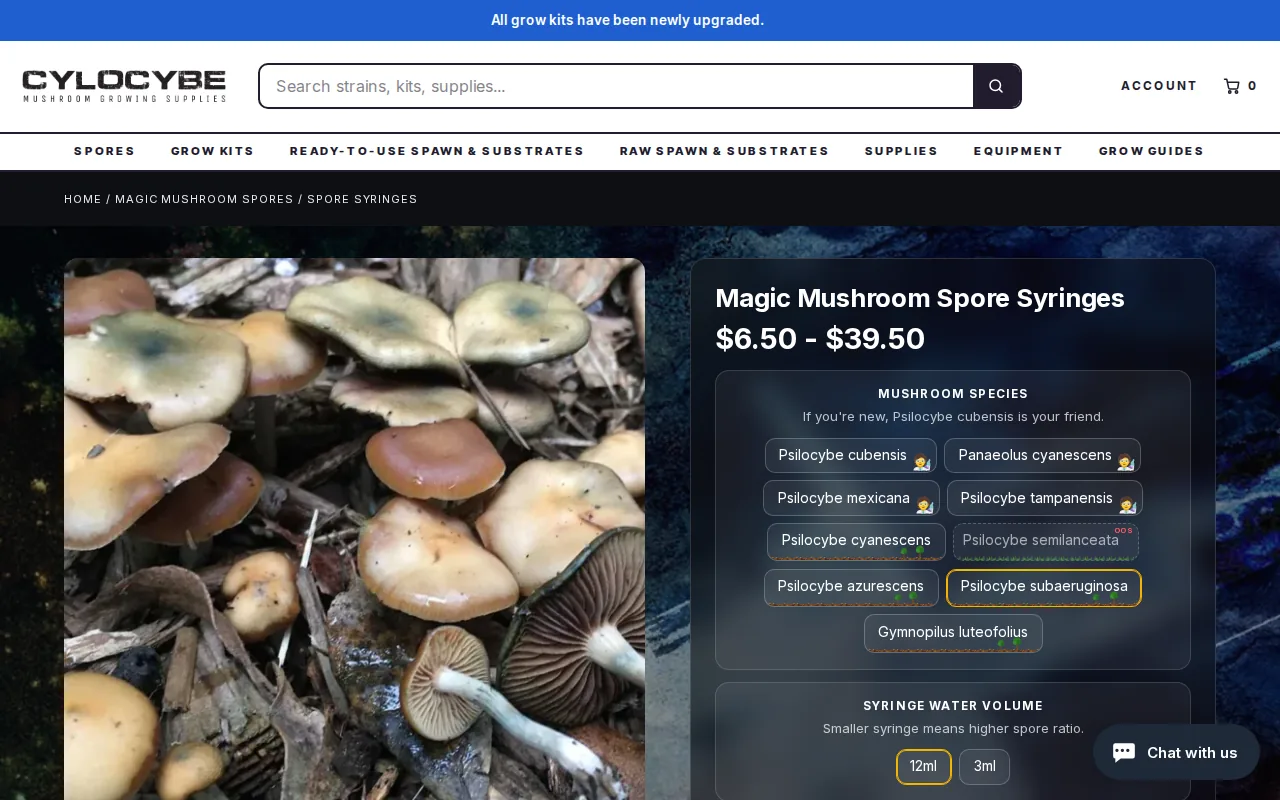
Peer-reviewed work on this species and related wood-loving fungi describes broad geographic variation and complex relationships among populations. Moreover, differences in appearance can occur, too. Therefore, this is another reason a casual photo comparison cannot establish a wild mushroom’s identity.
There is also a reported concern known as “wood lover’s paralysis,” a temporary loss of movement associated in some reports with certain wood-loving species. The cause is not established, and a direct link to psilocybin-pathway genes has not been shown.
Even so, that uncertainty is a reason for care, not a reason to test a wild specimen. We don’t give foraging or preparation instructions for psychoactive mushrooms.
9. Psilocybe serbica, a lesser-known European magic mushroom species
Psilocybe serbica is a European species that receives less attention than cubensis cultivars. It has a reported average psilocybin content of 1.34%. As with all such figures, that number describes a reported average rather than a guaranteed result for a sample.
Species names can also change or overlap in taxonomic discussions. A common or older name may not tell a reader how a specimen would be classified today. That matters when online pages repeat names without explaining their limits.
Less familiar does not mean more predictable. There is no basis here for claiming that this species produces a particular mood, visual effect, or level of risk. General psilocybin safety concerns still apply, including panic, impaired judgment, and the danger of misidentification if someone encounters it in the wild.
It belongs on a taxonomy-focused list because it is a named species, not because its reported content makes it a better choice.
10. Psilocybe baeocystis, a species with limited comparison data
Psilocybe baeocystis is a species sometimes discussed under common names such as Knobby Tops. This species has a reported average psilocybin content of 0.85%. Other sources describe its content as less well characterized, which makes direct comparisons especially uncertain.
Reported chemistry is only one part of the picture. The species name cannot confirm an individual mushroom’s identity, chemical content, or safety. A person who relies on an online description to identify a wild specimen risks confusing it with a toxic mushroom.
Some accounts link this species to the discovery of baeocystin, a related compound. That historical detail does not establish that the compound predicts a distinct subjective effect.
Keep the label in the “species to recognize by name” category. Don’t treat it as a reliable guide to strength or experience.
How the best magic mushroom strains compare on reported potency
The figures below are reported averages. They are not verified values for products sold under these names, and they should not be used to select an amount. The sources do not offer a single standardized test of all ten entries.
| Name | Type | Reported psilocybin figure | What the figure can tell you |
|---|---|---|---|
| Psilocybe cubensis | Species | 0.63% | A reported average, not a batch result |
| Penis Envy | Cubensis cultivar | 0.9% to 1.1%, average 1.0% | A reported cultivar estimate, not a guarantee |
| Golden Teacher | Cubensis cultivar | 0.5% to 1.5% | A broad reported range |
| Psilocybe semilanceata | Species | 0.98% | A reported average, not an identification test |
| P. azurescens | Species | 1.78% | A reported average, not a safe-use measure |
| Psilocybe cyanescens | Species | 0.85% | A reported average, not a batch result |
| Panaeolus cyanescens | Species | 2.5% | A reported average, not a recommendation |
| Psilocybe subaeruginosa | Species | 1.93% | A reported average, not a batch result |
| P. serbica | Species | 1.34% | A reported average, not a prediction |
| Psilocybe baeocystis | Species | 0.85% | A reported average with limited comparison value |
The table is a snapshot of reported numbers, not a ranking of safety or quality. Different sources may use different samples and methods. A percentage cannot tell you whether a specimen is correctly identified, nor can it forecast how someone will feel.
Keep the key distinction in mind: a reported average is not a product test. A name is not a guarantee. Neither is a safe-use guide.
Safety and legal considerations for all magic mushroom strains
Psilocybin can change perception, emotion, and judgment. Some people experience fear, confusion, nausea, or panic. A person whose awareness is altered may also face physical hazards, such as traffic or falls. Avoid treating a strain name or a potency chart as a way to control those risks.
Risks can be higher outside supervised research or clinical care. People with heart conditions should be aware that psilocybin may raise heart rate and blood pressure. Severe distress and harm can also result from misidentified mushrooms or contaminated products.
Do not combine psilocybin with other substances based on informal advice. If someone has taken a mushroom and becomes severely confused, unsafe, or physically unwell, seek urgent medical help. Keep them away from traffic and other hazards while help is arranged.
Legal rules vary by country and region, and they can change. A product being sold online, a species occurring naturally, or a practice being described as decriminalized does not establish that possession or sale is legal where you live. Check current local law through official government sources before acting. Our overview of psilocybin legality in Europe and around the world explains the key differences between countries.
Frequently asked questions
What is the difference between a mushroom species and a strain?
A species is a taxonomic group, while a strain or cultivar is a named variation within a species or cultivated line. For example, Psilocybe cubensis is a species, while Golden Teacher and Penis Envy are commonly described as cubensis cultivars. Names in informal markets may not guarantee a verified lineage.
Which magic mushroom strain is the strongest?
There is no dependable answer based on a name alone. Some published sources report higher average psilocybin content for certain species, but those values don’t establish the content of a specific mushroom. Different samples can vary, and comparing figures from different sources may not be like-for-like.
Can a mushroom’s appearance confirm that it is safe?
No. Appearance, habitat, and a common name are not enough to confirm a wild mushroom’s identity. Toxic species can resemble mushrooms people seek, and a mistaken identification can cause serious poisoning. Don’t eat wild mushrooms based on a photo, online description, or casual identification.
Are psilocybin mushrooms legal where I live?
It depends on your location and the current law there. Rules may differ for possession, sale, cultivation, or supervised services. A local policy change does not automatically make every activity legal. Check current official government information for your country or region rather than relying on old articles or seller claims.
Can strain names predict the effects of psilocybin?
No strain name can reliably predict an individual response. Effects depend on the substance and amount, along with factors such as a person’s biology, mindset, and surroundings. Reported descriptions are not clinical guarantees. Psilocybin can cause distress or impaired judgment, so claims that one name is always gentle or suitable for beginners are not a safety standard.
Conclusion
Use these names to understand broad differences between species and cultivars, not to choose a dose or judge safety. Our recommendation is to treat potency claims with caution and avoid wild-mushroom identification for consumption. For current risks or legal questions, check official health and government guidance before making decisions.